/*
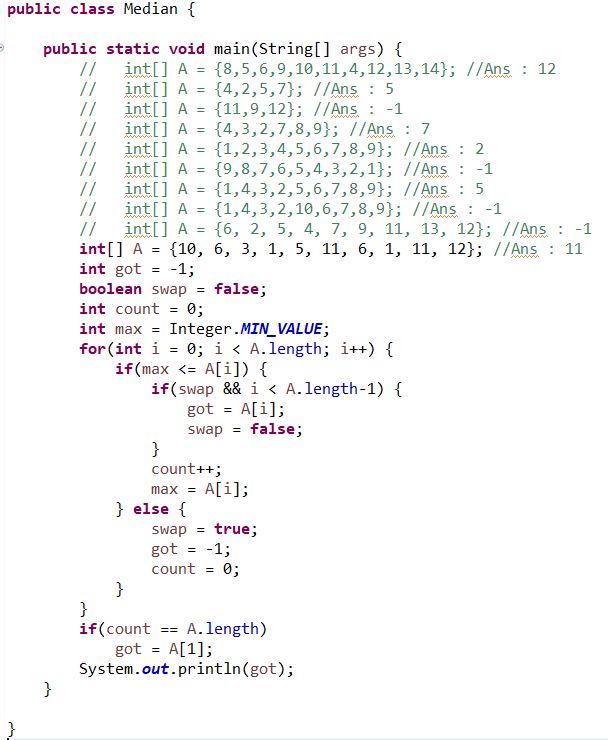
* Given an unsorted array of size N.
* Find the first element in array such that all of its left elements
* are smaller and all right elements to it are greater than it.
*/
public class Median {
public static void main(String[] args) {
// int[] A = {8,5,6,9,10,11,4,12,13,14}; //Ans : 12
// int[] A = {4,2,5,7}; //Ans : 5
// int[] A = {11,9,12}; //Ans : -1
// int[] A = {4,3,2,7,8,9}; //Ans : 7
// int[] A = {1,2,3,4,5,6,7,8,9}; //Ans : 2
// int[] A = {1,4,3,2,5,6,7,8,9}; //Ans : 5
int[] A = {1,4,3,2,10,6,7,8,9}; //Ans : -1
int len = A.length;
int max = Integer.MIN_VALUE;
int min = Integer.MAX_VALUE;
int maxI = -1;
int minI = -1;
boolean found = false;
for(int i = 0; i < len; i++) {
int value = A[i];
if(max < value) {
max = value;
maxI = i;
found = true;
continue;
}
if(min > value) {
min = value;
minI = i;
found = true;
}
if(max > value && maxI < i)
found = false;
}
if(maxI > minI && len-1 > minI+1 && minI+1 > 0 && found)
System.out.println(A[minI+1]);
else if(minI == -1 && found) {
if(A[0] < A[1])
System.out.println(A[1]);
} else
System.out.println(-1);
}
}
* Given an unsorted array of size N.
* Find the first element in array such that all of its left elements
* are smaller and all right elements to it are greater than it.
*/
public class Median {
public static void main(String[] args) {
// int[] A = {8,5,6,9,10,11,4,12,13,14}; //Ans : 12
// int[] A = {4,2,5,7}; //Ans : 5
// int[] A = {11,9,12}; //Ans : -1
// int[] A = {4,3,2,7,8,9}; //Ans : 7
// int[] A = {1,2,3,4,5,6,7,8,9}; //Ans : 2
// int[] A = {1,4,3,2,5,6,7,8,9}; //Ans : 5
int[] A = {1,4,3,2,10,6,7,8,9}; //Ans : -1
int len = A.length;
int max = Integer.MIN_VALUE;
int min = Integer.MAX_VALUE;
int maxI = -1;
int minI = -1;
boolean found = false;
for(int i = 0; i < len; i++) {
int value = A[i];
if(max < value) {
max = value;
maxI = i;
found = true;
continue;
}
if(min > value) {
min = value;
minI = i;
found = true;
}
if(max > value && maxI < i)
found = false;
}
if(maxI > minI && len-1 > minI+1 && minI+1 > 0 && found)
System.out.println(A[minI+1]);
else if(minI == -1 && found) {
if(A[0] < A[1])
System.out.println(A[1]);
} else
System.out.println(-1);
}
}
Bit simpler way - Traverse left to right to mark the index of largest number till the current index. Then traverse right to left to check if the current number is minimum & also check maxNum[curIndex] == -1
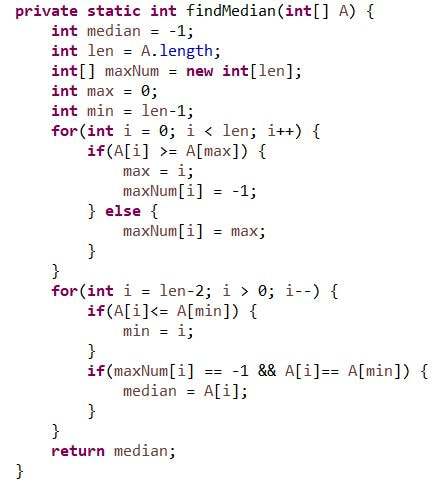
Above solution iterates the array twice, once left to right to find the index of maximum number in the left & then right to left to find the index of minimum number & then it compares if the current number is greater than maximum number in left & smaller than the minimum number in the right.
But below traverses through the array once & keeps the record of the number which is greater than all in its left & smaller than all in its right.
But below traverses through the array once & keeps the record of the number which is greater than all in its left & smaller than all in its right.